


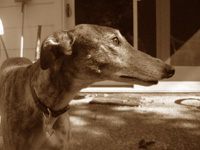











Greyhound FAQs
Do Greyhounds need a lot of exercise?
Greyhounds should be walked three to four times daily. they should be taken to enclosed grassy areas where they can sprint once or twice a week. (Unless injuries prevent it.) The walking is primarily so that they will empty themselves. A fenced-in yard is the best investment you can make for your Greyhound's welfare, and your peace of mind. These dogs must NEVER be trusted off-leash.
Are Greyhounds housebroken?
Greyhounds are kennel-broken, which means that they know to go outside and keep their living quarters clean. Allow them access to the outdoors frequently at first, and they quickly learn that their new home is the place they keep clean, and outside is the place where they relieve themselves.
Are Greyhounds easy to train and handle?
Greyhounds are extremely sensitive and intelligent animals, responding quickly to talk and touch as rewards. A stern voice quickly checks a greyhound. NO physical punishment should be used!
Do Greyhounds make good jogging companions?
Yes, however, their track experience prepares them for sprinting on dirt tracks only. Long exposure to asphalt or concrete may hurt or damage the pads on their feet unless they are allowed to acclimate gradually. You will also need to build them up slowly to your pace and distance.
Do Greyhounds make good watch dogs?
No. Greyhounds are far too gentle. Still, the psychological impact of a large dog can be a deterrent to would-be trouble-makers.
Why do Greyhounds wear muzzles on the track?
Greyhounds wear muzzles because as they turn the bend at the oval track, some of them may bump shoulders due to the centrifugal force of the trun. This could lead to a potential dogfight. Track officials prevent the slightest possibility by muzzling.
How old are Greyhounds that are available through GPA, and what is their life expectancy?
They range from about two years old to five or six, and have a life expectancy for 12 to 14 years.
How much does it cost to own a Greyhound?
While each adoption group varies in what is included in the adoption fee, they usualy include spay/neuter surgery, physical exams, and up-to-date vaccinations. Some also include heartworm test and preventive, dental cleaning, and a leash and collar, which includes and ID tag.
Greyhounds cost about a dolar a day to feed and all the love you can afford.
As is the case when adopting ANY kind of pet, you should be aware of the fact that emergencies sometimes occur, and you must be comfortable in the knowedge that your family finances can absorb the cost of an emergency. The daily care and feeding of any pet are only a part of the financial responsibilities involved.
Are Greyhounds good with children?
The answer depends on the children (and their parents). It must be remembered that these are adult dogs, who may have never been exposed to small children and their high voices and quick movements. While Greyhounds are, as a breed, very tolerant and sweet-natured, and would usually rather walk away than snap, they do have their limits, just as any other breeds. Children MUST be taught the proper respect for the dog, and not become overbearing in their actions towards the dog.
How are Greyhounds with other pets?
Greyhounds are friendly by nature, and socialize well as a result of their daily encounters with other Greyhounds in the racing kennel. Most can learn to accept INDOOR cats, but the introductory period must be closely monitored. A cat or other small animal running through your yard WILL be chased, more than likely. Remember always that these dogs have centuries of breeding to CHASE. Vigilance is essential. Interestingly, Greyhounds know their own kind, becoming very animated when they see another Greyhound.
What are Greyhounds fed?
A Greyhound's diet at the racing kennel consists of a "stew" of high-protein dry food and pet-grade beef, mixed with warm water and a dash of vegetable oil for a shiny coat. There are many ingredients which can be added occasionally for variety and taste-appeal, buttermilk, honey, vegetables (cooked or raw), cottage cheese, fish, even applesauce or V-8 juice.
The diet of a Greyhound at home will be greatly different from a racing diet. You must feed a good quality dry food, mixed with warm water. You can add canned, fresh or frozen vegetables, if you wish. Always have plenty of fresh drinking water available. Feed once or preferabely twice a day.
Bones can be very dangerous for your Greyhound. Do not allow a Greyhound to have steak bones, they are too small. Chicken or pork chop bones should NEVER be given to ANY dog.
How big is a Greyhound?
Greyhounds stand about 27-inches at the shoulder. The females usually range from 50 to 70 pounds, and the males from 60 to 80 pounds.
Do Greyhounds shed?
Being a short-haired dog, they shed only a little, more so in the spring and fall. Frequent brushing is recommeneded, especially during those seasons. It helps maintain a healthy coat, and Greyhounds enjoy being brushed. (With a GENTLE brush, please.)
How are Greyhounds different from other breeds?
Greyhounds are more susceptible to anaesthesia, requiring only a fraction of the anaesthetic used on another breed of the same size, and taking longer to recover from it.
Flea collars and internal flea preventive medications are NOT safe for use on Greyhounds.
All dogs may chase cats or rabbits, etc., but a Greyhound is fast enough to catch them. For this reason, they should always be exercised in a fenced enclosure, or on a hand-held lead.
Be careful of flea shampoos - if the label on a medicated shampoo says, "not for se on sighthounds," DON'T USE IT!!!
Wormers should be used only on the advice of a Veterinarian. Take a fecal sample so that it can be analyzed. DO NOT use over-the-counter wormers!!!
Do Greyhounds really make good pets?
Every Greyhound which is raised properly - given attention and affection, especially early in life, will make a wonderful, loving, devoted pet. Greyhounds quickly become attached to their new owners, and thrive on pleasing them. Extremely enthusiastic greeters, they never tire of being petted.
Greyhounds love comfort as much as they love to run, and will spend hours curled up on a soft blanket, or at their master's feed. (Or, in bed with their masters, if they're allowed!!!)
Many people who own Greyhounds say they're the best pets they've ever had, and they'd never own another breed.
Noble, sensitive, intelligent, beautiful -- no wonder they were once the pet of royalty!
Copyright © 2001 Greyhound Pets of America. All rights reserved.
Privacy Policy - How to Donate - About GPA - Contact GPA - Home