 GPA
Communique
GPA
CommuniqueGPA
Communique
The Bulletin of Greyhound Pets of America--April, 1999
|
1999 Annual GPA Convention Please support GPA and our GPA Orlando Chapter by attending the 1999 Convention. The Orlando Chapter is very excited about being the convention host. Make plans to attend (and see other sights in Florida) on Sept. 25-27. Welcome to Debra Sanford, Kansas, and Bev Doan, South Nevada, who have been awarded full Chapter status. Cat Friendly-What does that mean? This is a subject that comes up often in discussions with people in the Greyhound adoption industry. Many times I've heard from placement folks, "I need X number of cat-safe Greyhounds to fill pending adoption applications." This seems to be a widespread concern of many adoption groups, GPA and otherwise, which begs the question: How do we determine if a Greyhound is cat safe? The most common method seems to be using a test cat, one that is displayed in front of the screening subjects, who are usually kenneled. This method would seem to reinforce the training techniques used during the Greyhounds, previous race training: prey-chase-kill-reward (praise). Foster home environments should produce better results if cats and other small critters are part of the package. Even in these situations a strong alpha presence (human) must define the pack behavior training that is necessary to modify unacceptable behavior. I will offer some observations based on our 15-plus years experience. When we started out, we were very conservative about placements that involved cats and small dogs, based on the cautions we had heard from others and the basic knowledge that Grey-hounds were bred to chase and kill small game by sight. As we gained experience, we began to realize how intelligent Greyhounds are, and with proper detraining can learn that small furry critters are pack members that are at the least tolerated, not chased-except for mutual fun. We consider that 70-80 percent of the Greyhounds that come through our program to be acceptable with cats and other small animals. Our screening process consists of observation of the dogs prey drive tendencies. Dogs that are difficult to switch from prey drive to pack drive using outside (human) stimulus, may not be suitable for placement with other small animals, but we have found this number to be only 20-30 percent of the population. We believe the most important reason for our successful placements is educating the new owner on how to deal with these issues. First, we loan training muzzles to any adopter with small pets. Second, we spend a lot of time explaining the methods for training their new family member to accept these lure-like critters as members of the pack. The new owner must establish themselves as pack leader and make clear to the new Greyhound pack member what is acceptable behavior. We all know how intelligent Greyhounds are. The emphasis needs to be on educating the new owner on how to train their new family member. I hope that this stimulates some ideas for more successful adoptions. GPA and the Internal Revenue Service All chapters have received a request for financial information for reporting to the IRS. An ugly but necessary task to be accomplished. I would like to thank all chapters who have been so kind to send the information early. That has allowed me to get started with accumulating totals for all chapters and preparing computerized data for Patricia Bates, CPA, who will be finalizing our return to the IRS for the 1998 filing. I have asked that all of our chapters complete the first three pages of the 990 even if your gross receipts were less than $25,000. The reason behind this is to get a better picture of what all of GPA is doing.
With some of the questions that have been asked, I thought you might be interested in knowing how all of our chapters are tied together for the IRS and what it takes to keep the IRS informed of our chapter activity. So here goes-and I will try not to bore you with this very dry subject! First, a few definitions are in order: Employee Identification Number (EIN) - All nonprofit corporations/organizations (with or without paid employees) must obtain a federal EIN. The EIN is used to identify the organization and is used on all federal tax returns and reports. Each GPA chapter is required to have an EIN. This number identifies your individual chapter. Group Exemption Number - A four-digit number assigned by the IRS. This number ties all of our chapters together when reporting or writing to the IRS. When a sub-chapter applies for their EIN, this Group Exemption Number should be part of the application. Tax Exemption - When applying for tax exemption, it serves as a notice to the IRS that your organization is a public charity, not a private foundation. Tax exemption assures others that GPA is a bonafide 501 (c) (3) group. Then, and only then, can you assure contributors, grant agencies and others that GPA is a qualified 501 (c) (3) tax exempt, tax deductible organization listed with the IRS. Consent Form - Every year, each local organization/chapter must authorize the central/parent organization in writing to include it in the group return and must declare, under penalty of perjury, that the authorization and the information it submits to be included in the group return are true and complete. If you look in the Policy & Procedure Manual (Appendix-D), you will find a letter dated July 21, 1989, and addressed to Greyhound Pets of America from the Internal Revenue Service. The letter identifies the EIN for the parent organization and identifies a Group Exemption Number (4102). GPA also has an EIN which represents the "group reporting" and is tied in with the four digit Group Exemption Number along with the individual EIN from each chapter. The parent organization has yet another EIN which is used when reporting separately. The 1998 filing will be the first year that the parent organization has filed. Not that we are receiving at least $25,000 in gross receipts, because we are not, but because it will give all of GPA and the IRS a total financial picture of Greyhound Pets of America. By September, of each year, the GPA Treasurer is required to send the IRS a roster of subordinates. The roster will include a list of new chapters added during the year, a list of all deleted chapters, a list of any changes in the contact names and addresses and a list of all active chapters including the individual EINs for each chapter. The IRS refers to our chapters as subordinates to the parent corporation. This roster is accompanied with a cover letter that states that any new subordinates added has formerly requested, in writing, to be added to the Exempt Roster, that the new subordinate(s) is not a foundation and that they are not a school claiming exemption under Code Section 501 (c) (3). The letter and roster document the chapters who will be reported in the Group Return (Form 990) for the current year. The Consent Form is a requirement set by the IRS and is kept in the GPA Treasurer's file for all chapters. The Consent Form protects GPA in the sense that all financial data are true and accurate and is signed by an official representative of your chapter. At the end of the year, you know the rest. It is your job to provide complete and accurate financial information to the GPA Treasurer. Nonprofit corporations must file by May 15 of each year. Your question may be, then why do we have to give our financial data to the Treasurer before April? The answer is because it takes time to accumulate the data for all of our chapters and more important, is the fact that some States (not all), require a copy of the completed Form 990 to be filed along with the individual state form. Copies of the completed GPA Form 990 must also be sent to those chapters who have either registered or incorporated within their State. So, as you can see, it is very important that we are ready to file prior to the May 15 date. GPA has thirty chapters, however, three of them have their own exempt status and file their own Form 990. They do not report to the IRS as part of the Group Exemption. These chapters have been asked to submit copies of their Form 990 to the GPA Treasurer after the May 15 filing date. Likewise, there is one chapter who files separately but under the umbrella of the parent organization. This chapter has also been asked to submit a copy of their 990 to the GPA Treasurer after the May 15 filing date. To further complicate matters, GPA is a California corporation and as such, must also file with the California Attorney General's Office (Registry of Charitable Trusts) each year. The California CT-2 Form is a fairly easy form to complete, however the completed annual return (IRS Form 990) must be attached. To make things easier for the Treasurer (present and future), I have developed a spread sheet using the QuattroPro software package. The chapters are spread across the data document and as I receive completed Form 990's and after I have assured that each one is in balance, I enter the data into the spread sheet. It is planned to send the spread sheet and the data (copied to a diskette) to Pat Bates where her office will convert the QuattroPro data into their tax package system. Keep your fingers crossed that this will work and that Pat will not have to re-enter the data. So there you have it. Everything you wanted to know but were afraid to ask. National Review Committee The National Review Committee continues to make progress in its review of GPA policies and procedures, as outlined in the last Communique. We have nearly finished our review of GPA's committees and the policies governing those committees. Some of our recommendations involve tweaks, while some of them suggest more substantial changes. Our next task is to review chapter and sub-chapter requirements. You will be sent our recommendations in detail prior to the next annual meeting. Thanks to those who turned in their surveys (sent in the last newsletter). If you haven't yet completed yours, we'd still like to get it. Let us know, at the address below, if you didn't receive a survey or need a replacement and we'll send it right out. We'll make the statistical results (no personal data) of these surveys known at a later date, perhaps in the next Communique. For a survey, write: Jim Jeffers, 16391 Valley Springs, Chino Hills, CA 91709 GPA is on the Internet by Jim Jeffers Greyhound Pets of America now has its own web site, found at: .........http://www.greyhoundpets.org I'd like to thank Deborah Oldham and Kari Morrison Young for their extensive help in putting this page together. The web site is divided into six sections: Introduction, which tells about the mission and origin of GPA; GPA Chapters, which gives the locations and contact info of all chapters and sub-chapters; News, which will present news updates to keep you in touch with what's happening inbetween newsletters and include the Communique online; Calendar, a list of upcoming events mainly related to the national organization; Interact, which shows the various ways you can get in touch with GPA folks (including our new email lists); and Links, giving links to other web sites of interest to our members. Future plans include providing web pages for those chapters which don't yet have one. We're working on a page right now for Louise Truber and the Northwest Arkansas Chapter. Maxwell Award
In the Library by Louise Truber, Resource Librarian
1998 GPA Greyhound Survey All Chapters have responded to the Greyhound Survey. GPA placed 2,978 Greyhounds for the 1998 calendar year. The survey also identifies that 148 Greyhounds were made available by GPA Chapters to other GPA chapters and is included with the total count. An additional 972 Greyhounds were made available to non-GPA adoption agencies. Although the survey did not ask for the number of replacements, I know of approximately 49 to 50 that were replaced but are not included in the above count. Maybe next year, we should include this in our survey. It may help to determine better methods of screening. Food for thought-Replacements may be a good topic for a round table discussion. Sharing screening methods could help all of us. GPA Helps Put Dog Walk into Guinness by Bob Trapp, GPA/Central Texas The Texas Hearing and Service Dogs sponsored a "Mighty Texas Dog Walk". The Guinness Book of World Records folks have, or I should say had, a record held by some folks in Connecticut. It is for the largest number of dogs/people in/assembled for a walk. The walk was for three miles and the record was 1,086 dog walkers. Our count for the walk was 2,112. GPA/Central Texas had the largest contingency of dogs and that was well over sixty. There were other greys there as well but they weren't part of GPA. We got some new members out of the walk by some people that had just moved to the area and even a dog placement. |
Gifts to Non-Profit Organization: By Kimberly C. Harris, Esq. As an attorney, I am often asked about the "rules" for making charitable contributions. Most of the inquiries stem only from the clients sincere desire to contribute money or property to an organization that has positively impacted their lives and in whose mission they believe. A few inquiries stem from the client's desire not to have to pay to Uncle Sam more taxes than are absolutely necessary. The same questions and concerns are present in either case:
This article is intended to provide some basic answers to those questions. Who You Can Make Charitable Contributions To A charitable contribution is one that qualifies as a tax deduction on your federal income and/or estate tax return.You can take a deduction for contributions made to non-profit organizations which meet the tax-exempt requirements of Internal Revenue Code 501(c)(3). The list of organizations meeting such requirements is lengthy and includes churches, public charities, educational institutions, libraries and other non-profit organizations such as Greyhound Pets of America (GPA) and private foundations. What you can give
A contribution of $250 or more, however, is tax deductible only if you obtain the organization's contemporaneous written acknowledgment of it. Personal Property. Contributions of personal property (both tangible and intangible) are more complicated than contributions of cash. As a general rule, the fair market value (FMV) of the property at the time of the contribution is tax-deductible, but there are exceptions. Those exceptions don't often come into play if you are donating property that has decreased in value, such as an automobile or a motor home, but they will certainly come into play if you are donating property such as stocks or works of art that have probably increased in value. If you intend to make a contribution of tangible or intangible property that has increased in value, you should consult your attorney or accountant to determine how the IRS valuation rules apply. As a general rule, if you plan to claim a deduction of more than $5,000 for donated property, you must obtain an independent appraisal of the property. Real Estate. Contributions of real estate are sometimes very attractive for donors who own highly appreciated real estate. This is because you can generally deduct the FMV of the real estate at the time you donate it, regardless of what you paid for it. There are a couple of exceptions. You do not get a FMV deduction for property that you have owned for less than a year. Again, you should consult your attorney or accountant to determine how the specific IRS rules apply. Services. Finally, you can always donate your services. While there are no charitable deduction allowed for the actual time you donate, you are generally able to deduct your out-of-pocket expenses (such as travel, accommodations, etc.) incurred in providing the service. When you should make a contribution and how it benefits your taxes. While the answer to when a donation should be made is largely a matter of personal preference, since some people enjoy seeing the fruits of their contributions while others prefer to remain anonymous, how it will benefit you tax wise depends on the organization you contribute to, your adjusted gross income (or value of your estate where estate tax savings are also desired), and the amount of planning you do. Let's look first at the federal income tax benefits. Contributions to most private foundations and non profit organizations, such as GPA are deductible up to thirty percent (30%) of your adjusted gross income in the year you make the contribution. Certain donations of appreciated property are subject to the thirty percent (30%) deduction limit as well, whether you contribute it to a public or private charity. The remainder of the deduction is spread out over the next five years. Example: Sandra makes a $5,000 donation to her local GPA chapter in 1999, a year that her adjusted gross income for federal income tax purposes is $50,000. Assume that GPA has a 30% contribution base. Sandra can deduct the entire $5,000 contribution on Schedule A of her 1999 Tax Return because $5,000 is less than 30% of $50,000. Assume, instead, that Sandra donated a piece of appreciated property to GPA in 1999, the fair market value of which was determined to be $100,000. The most that Sandra can deduct as a charitable contribution in 1999 is $15,000 (30% of her adjusted gross income of $50,000). Sandra can spread out the remainder of the deduction ($85,000) on her tax returns over the next five years. As you can see, contributions to charitable beneficiaries can gain you substantial income tax savings. For those of you who have assets that will exceed the allowable estate tax exclusion, when you pass away, estate taxes may be a concern. At the present, the IRS collects an average 37% in taxes for assets above the exclusion amount. For example, if your estate is valued at $700,000 and you die, your estate will pay federal taxes on 37% of $75,000 ($700,000 - the $625,000 exclusion) unless all of your property passes to a legally recognized spouse. For many of us, there is no legally recognized spouse to whom our property will pass, and, while we have other beneficiaries; children, siblings, nieces, nephews, partners and friends, federal law doesn't provide the same tax advantages when we leave property in excess of the federal tax exclusion to them. If you fall into that category of people who will most likely have to pay estate taxes and you have charitable inclinations, there are both income tax savings and estate tax savings available with a little planning. Suppose, for instance, you are sure you want to give something to an organization such as GPA, but are not sure you can afford to part with assets that are still providing income for you. In that case, a charitable trust may be a very attractive alternative. One specific type of charitable trust, a Charitable Remainder Trust, is very popular and is easily illustrated. To set up such a trust, you, the donor, contribute property to the trust, and name yourself both as trustee and the income beneficiary.The trust pays you a fixed dollar amount each year for the rest of your life. Upon the death of the last income beneficiary, the trust is dissolved and the nonprofit organization receives the trust property. You get the charitable contribution deduction in the year the trust is created and (here's the estate tax benefit) the value of the property you place in the trust is excluded from your estate for tax purposes. Example: Janet owns $800,000 in assets, $200,000 of which is in stock she paid $50,000 for 20 years ago. She is unmarried. She currently has a will that leaves all of her property to friends and siblings. She passes away in the year 2000, when the estate tax exclusion is $675,000. That much of her property will pass to beneficiaries free of estate taxes. Her estate will pay approximately $47,250 in estate taxes (37% of $125,000). Assume, instead, that she creates a charitable remainder trust naming GPA as the beneficiary, and funds it with the stock. GPA sells the stock and invests the money in a safe mutual fund. No taxes are paid. Janet, as the trustee and income beneficiary, specifies in her trust document that she will receive 7% of the value of the trust property ($200,000) as an annual income for the rest of her life. The IRS' calculation of Janet's charitable deduction will start from a donation of $200,000, and the $200,000 of stock will not be included in Janet's estate when she dies. Since the $200,000 has been removed from her estate, the value of her estate when she dies is $600,000, which is below the $675,000 exclusion amount. Her estate, therefore, owes no estate taxes. There are other charitable trusts which operate similarly, but space prevents their coverage here. The basic drawbacks to any charitable trust are that formal documents must be prepared, title to the trust property must be properly transferred and the requirements of Internal Revenue Code 664, which governs charitable trusts, must be complied with. Further, once you create the trust, and it becomes operational, you cannot change your mind and regain legal control of the property you have given to the trust. Obviously, illustrations in this article have been kept simple to point out tax benefits of making charitable contributions. The information contained herein is not intended to be tax advice. Everyone's tax situation, family situation and philanthropic mind set is different. From a tax deduction standpoint monetary contributions are pretty straightforward and you should need no help with them. If, however, you plan to make a sizeable property contribution to GPA (or any other non-profit organization) you should consult with an attorney or accountant to determine timing and valuation issues so that you will receive the maximum tax benefit allowed by law. This article is reprinted with the permission of Kimberly C. Harris. Kimberly is an attorney whose practice concentrates on tax and estate planning. She is licensed in both Texas and Georgia. Silent Symptoms of Babesia and Ehrlichia by Carol Osborne, GPA/AZ This story is being told to help alert you to a few, very silent or subtle, symptoms of Babesia and Ehrlichia. If your Greyhound is giving you signs, please have a tick panel done immediately. These two tick-borne diseases are very serious, and often life-threatening.
Depression is a symptom and now we know we had mistakenly thought she was bored. The boredom did not last long and Brooke would be up and playing again. We thought that maybe after a while we would get another Greyhound as a companion dog for Brooke, and that would probably stop the boredom. One problem Brooke did have when we got her, was an eye infection and a stopped-up tear duct in her right eye. A little salve from the Vet fixed the infection but her right eye still leaks and that bothers us more than it does her. I am telling you about the eye because from time to time both eyes would be bloodshot. A little salve and her eyes were clear. Bloodshot eyes are a symptom. One other thing, thinking back on the signs Brooke was trying to give us, she would cough slightly and infrequently. We had a Whippet that coughed on and off for 15 years of her very healthy life. So no real thought was given to Brooke when she coughed slightly. Coughing is a symptom. Brooke did not have a hard time swallowing or so we thought, but it did take her a long time to lap up very little water. Was this because of difficulty swallowing? Difficulty swallowing is a symptom. We saw no signs of swallowing problems when she ate. Brooke had come to be a well-adjusted Greyhound. Then came Fall and time to prepare for the annual GPA Convention to be held in Council Bluffs, Iowa. We packed up the motor home and left Central Arizona in mid-September and headed off to Ohio and Indiana for a visit with relatives and friends before going to Iowa. Our stay in Indiana and Ohio was very pleasant and Brooke had the time of her life with my sister's three greyhounds and 15 acres to run. The hounds had a great time running and playing together.
She would play and race around the back yard and go on her daily walks but there were times when she seemed just simply bored/depressed. We planned a trip for January 12 to visit a sick friend in California. Brooke seemed her happy self and loved meeting our friend's Boston Terrier, but on the third day in California (January 15) something terrible happened. It was time (6:00 a.m.) to take Brooke out for potty and walk. Brooke looked disoriented (or maybe she was in pain), but she could not or would not go down the motor home steps. So, I lifted her down and proceeded on a walk, but she was ever so slow and kept looking like she didn't know where she was. (Again, maybe I misread this and she was really in pain.) Greyhounds seem to be so tolerant of pain and discomfort, at least that has been our experience having had three greys before Brooke. When we came back from the walk, I had to lift her into the motor home. About three hours later, she seemed to come around and wanted a drink and treats. So, of course she had them. Still, she wasn't acting right-kind of quiet and subdued. We left the next afternoon and began our return trip home. We arrived home early on Sunday and Brooke would not run or play as she usually does when we return from a trip. For the next few days, she seemed to be her old self again, but we decided to make an appointment to see the Vet for blood panel, etc. It was time we did that again since she had been with us for a year. I made the appointment for 1/28/99 but changed that to an earlier date because Brooke was beginning to be in a lot of pain and could not move her neck very well and could not shake her head like dogs do. Neck and back pain is a symptom for Ehrlichia more so than Babesia. On Thursday, January 21, we had x-rays taken of her neck. At this point, Brooke had a hard time putting her head down to pick up toys or treats. Lucky that she normally feeds and drinks water from a food stand. The x-rays showed that two of her vertebras lacked space between them and it appeared as though she may have had an old injury. We knew of nothing she had done that would cause that. The Vet put her on Robaxin (an anti-inflammatory). On Sunday, her pain was so very bad that I gave her an aspirin (I had given her an aspirin once or twice before this). On Monday (1/25/99) she was in so much pain that she had held herself for more than 15 hours before she finally tried to urinate. She cried out in pain just trying to pee, because of the position and her left leg must have hurt terribly because she kept lifting it. Maybe a pinched nerve? I called the Vet and asked that she prescribe a pain killer and she prescribed Hycodan which is a narcotic. I gave Brooke * tablet on Monday morning and never gave her another one. It allowed her to sleep most of the day. We still had no idea or inclination of a tick borne disease. On Tuesday, a chiropractor friend of ours came by the house (about 10:30 a.m.) and treated Brooke with this activator instrument. She corrected about nine or ten different places up and down the vertebrae and in her neck. Especially in the neck area behind her left ear. By 5:00 p.m. Brooke went outside through the dog door and did her business, ate, drank and went back to her bean bag. On Wednesday, the Chiropractor gave a second treatment but only in two or three places. Within a couple of hours, Brooke was up and about. Not fast or anything but at least up and seemed to have only minor pain if she moved certain ways. Her energy level, of course, was very low. We were really happy that Brooke seemed to be getting better and was not in so much pain. We had kept the original 1/28/99 appointment with the Vet and had a complete blood and chemistry panel done. It is interesting to note here, that when blood was drawn, Brooke bled quite a bit. This was unusual because when blood had been drawn for heart worm and T-4 tests prior to this date, she did not bleed at all. We did not, nor did the vet, say anything and the technician put a bandage on the entry point and off we went for our daily walk in the local park. The next day, late Friday afternoon, the Vet called and was very concerned about the blood results and especially the platelets. Brooke's Pack Cell Volume (PCV) was a very low 21%. She was very anemic. We discussed doing the Ehrlichia & Coombs Auto Immune Test and had those done too; both tests were negative. The Vet called in a prescription of Doxycycline and Prednisone, just to be on the safe side until a Babesia test could be run. The results would be back from the lab on Monday. There have been recent Babesia cases in Southern California where we got Brooke, and only God knows where else she may have been. She is not tattooed, so she has never been on the track and we don't know her real age but are guessing that she is approximately three years old. By this time, Brooke had become lethargic-eyes wide open, pupils dilated and she seemed to sleep in this state. Lethargy is a symptom of Babesia. On Wednesday, the Vet did another PCV Test to see if the meds may have brought the cell volume up. This latest test showed 51%, so it was good that she was put on Doxycycline. At least her cell volume had improved. During this time, we never saw Brooke close her eyes. The Babesiosis Test was Positive. A titer of 1:80 which as we understand is the active point. We have heard that if the titer is around 1:40 or less, then treatment may not be necessary. We don't pretend to know any of the facts or reasons. We just knew it was time to do something for Brooke before we lost her. She was getting weaker and weaker and the energy level was nil. By this time we had subscribed to the Tick-List (on the Internet) which is owned and operated by the same folks that have the Greyhound-L. We had been in constant contact with Lynda Adame (one of the owners of the lists) and she was extremely helpful. (Lynda had been Brooke's foster mom and was more than just casually interested.) The Tick-L is a very interesting and knowledgeable site regarding tick diseases. If your hound(s) are showing symptoms, we recommend that you subscribe. Lynda informed us that there is a treatment (recently approved by the FDA within the last year or so, and has a 95% to 97% chance of curing) for Babesia. Our Vet had also located the cure which is a serum called Imizol. It is a two shot series given two weeks apart. Brooke got her first shot on Friday (2/5/99) and we scheduled an appointment for her second shot 2/19. The shot is a painful one, given under the skin in the neck area. She yelped loud & clear but it only lasted a second or less. It must burn upon entry. Sometime between the two shots, Brooke finally closed her eyes when she was resting. That was quite a relief to us. We watched her like a hawk and saw signs of improvement on a daily basis. Six days after the first shot, she ran for the first time in weeks. Our yard is not very big, but large enough for her to get a good run if she runs it several times. She circled the yard about four times, not at full speed, but a healthy run. That tired her and she came inside to rest. Her appetite is very good and she is asking for treats. One of her favorites is carrots and she had been turning them down during this episode, but now she wants them again. It is strange that she refused one of her very favorite treats (Health Nuggets) and would not eat them until eight days after her first shot. I should tell you that during this time of not knowing what was wrong, we changed her diet from a dry kibble (Iams Chunks) to dry kibble and Pedigree canned dog food. This was to entice her to eat, and it worked. Her weight is back up to normal (she had lost four to six pounds) and she loves the Pedigree with the Iams dry kibble. So I guess this will be her normal diet two times a day. On the day of her second shot, we had another blood panel done and the results were good with everything testing within normal ranges. On March 15 we had another Babesia test done and are waiting for the results. Brooke still has good days and bad/low energy days, but she appears to be getting back to being a normal Greyhound. She is now enjoying her daily walks, her four laps around the yard (when the mood strikes), an occasional run at the soccer field and she said to tell you that she hopes to see you at the GPA 1999 conference. |
 As a professional nonprofit corporation,
we should be in a position of knowing our true financial state
and our various methods of operation. This information is generally
required when applying for grants which is a viable option for
our corporation.
As a professional nonprofit corporation,
we should be in a position of knowing our true financial state
and our various methods of operation. This information is generally
required when applying for grants which is a viable option for
our corporation. Offtrack Greyhound, the quarterly
newsletter published by Greyhound Pets of America/California
Adoption Center, won the Dog Writer's Association of America's
(DWAA) prestigious Maxwell Award for Best Local Newsletter of
1998.
Offtrack Greyhound, the quarterly
newsletter published by Greyhound Pets of America/California
Adoption Center, won the Dog Writer's Association of America's
(DWAA) prestigious Maxwell Award for Best Local Newsletter of
1998. Dogs"
and assorted booklets
Dogs"
and assorted booklets
 Money. You can always give
money. The expense involved in running a nonprofit organization
is tremendous and cash donations are always appreciated. No amount
is too small. You can donate less than $250 and not have to get
written acknowledgment of your donation in order to deduct it
on your federal tax return.
Money. You can always give
money. The expense involved in running a nonprofit organization
is tremendous and cash donations are always appreciated. No amount
is too small. You can donate less than $250 and not have to get
written acknowledgment of your donation in order to deduct it
on your federal tax return.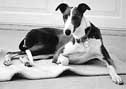 On January 7, 1998, we adopted
Brooke, a beautiful blue and white female Greyhound. She was
such a happy dog with her tail wagging almost unendingly. She
had been tested for all tick diseases with negative results.
Being unfamiliar with her surroundings, she was quiet the first
night with us. Her first three days, she continued to be quiet
and unsure of herself, but on the fourth day, she was a real
Greyhound in a secure environment and full of play for short
spurts. We just thought she got bored playing by herself and
with us.
On January 7, 1998, we adopted
Brooke, a beautiful blue and white female Greyhound. She was
such a happy dog with her tail wagging almost unendingly. She
had been tested for all tick diseases with negative results.
Being unfamiliar with her surroundings, she was quiet the first
night with us. Her first three days, she continued to be quiet
and unsure of herself, but on the fourth day, she was a real
Greyhound in a secure environment and full of play for short
spurts. We just thought she got bored playing by herself and
with us. Brooke led the pack and never
seemed to get quite enough, let alone too much. We left Indiana,
stayed for two days in Thor, Iowa, and then on to Council Bluffs.
Some of you may remember Brooke being at the conference. After
the conference we returned home and things were very normal for
Brooke until January 1999. It seemed again, that Brooke had suddenly
become bored/depressed and occasionally she would have a drippy
nose. Not much, but some. Nose dripping is a symptom.
Brooke led the pack and never
seemed to get quite enough, let alone too much. We left Indiana,
stayed for two days in Thor, Iowa, and then on to Council Bluffs.
Some of you may remember Brooke being at the conference. After
the conference we returned home and things were very normal for
Brooke until January 1999. It seemed again, that Brooke had suddenly
become bored/depressed and occasionally she would have a drippy
nose. Not much, but some. Nose dripping is a symptom.