FAQs | Contact | Donate...
Greyhound
Pets of America
Frequently Asked Questions
1 800 366-1472
.
..www.greyhoundpets.org
..
Home | Adoption | Donate | Calendar | Chapters | News | Vendors | Memorial Fund | Programs | Web Radio | Media | Giftshop
|
Frequently an adopted greyhound is completely housebroken right from the start. Greyhounds are kennel trained. This means that they are taught not to soil their own space. At the track greyhounds are taken three or four times a day to a turnout pen to relieve themselves. As a result, they do not learn how to tell us that they have to go out. There may be an accident or two, but this is best avoided by taking your greyhound out frequently and giving it lots of praise when it finds the right spot. Watch it closely at first, and it will quickly learn that its new home is the place it keeps clean and outside is where it relieves itself. When letting your greyhound into your yard to go, don't distract it; you want it to focus on the reason for being outside. Greyhounds, although leash trained, need to be taught to go to the bathroom while on a lead. This requires a little more time than teaching them where the door is. Frequent walks, with timely praise, teach them that their new home is the place they keep clean, and outside is the place they "go".
|
|
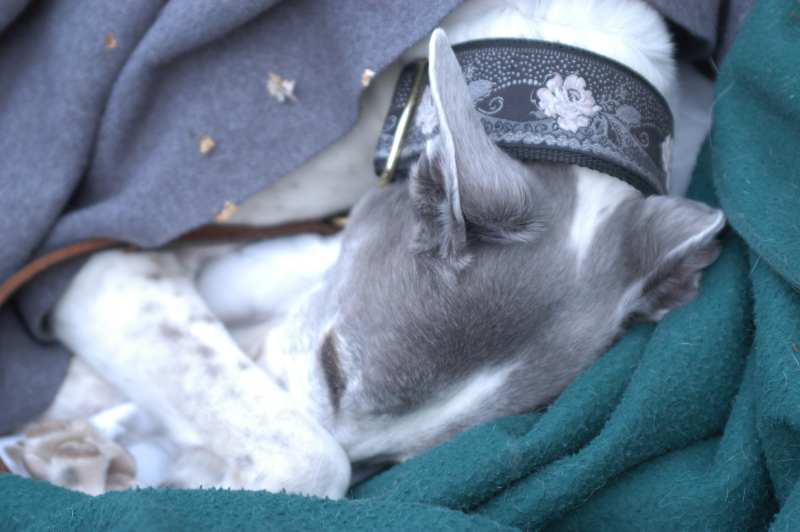
No. Greyhounds need to be indoor pets. Because of their thin coats and lack of body fat, they cannot stand temperature extremes. Even in moderate climates such as Southern California, it gets too hot and too cold outside for greyhounds. They can't tolerate all day in the garage, either--especially in the summer in So Cal. Some folks who are gone all day install dog doors, which allow their greyhound to come inside when he gets too hot or cold during the day. GPA/CA--OC&GLA requires every adopter to commit to keep his or her greyhound as an indoor dog.
|
|
Greyhound males stand 26 to 30 inches tall at the shoulder and weigh between 65-85 lbs. Females stand 23 to 26 inches tall at the shoulder and weigh 50 to 65 lbs. They come in many colors: black, white, several shades of brindle, fawn, red, blue or a combination of these colors.
|
|
Greyhounds placed through the GPA adoption program are usually two to five years old. The younger dogs may not have qualified for racing. Most of the older dogs were retired from racing because they were no longer competitive. GPA also places dogs from local animal shelters, or from families who can no longer keep their dog. Retired greyhounds enjoy many years of good health. With proper care, they have a life expectancy of twelve years or more.
|
|
Greyhounds are the fastest breed of dog. But they are sprinters without a lot of endurance. A retired racer is quite content to be a "couch potato" and spend most of the day sleeping. Greyhounds can never be trusted off leash out of a fenced area. Raised in such a sheltered life at the track, a greyhound has no street smarts. greyhounds can run at speeds of up to 45 mph and will chase moving objects. Because greyhounds are sighthounds (not scenthounds), a loose one would run so fast and so far that it would quickly get lost, if not hit by a car. Exercising your greyhound with walks and occasional chances to run around in a fenced area is all that's required. At the track, greyhounds are used to running every three to four days, so you may see a pattern to your dog's energy peaks. You are the best playmate your greyhound could have and it will follow your lead regarding how much exercise it gets. Most greyhounds will enjoy an occasional sprint in an enclosed, grassy area. Some of them love to run; others are simply not interested after they retire. Greyhounds also make great jogging and hiking companions once they become accustomed to longer distances and the new pace. Since they have been trained as sprinters, their endurance must be built up.
|
|
A greyhound coming into your home will be puppy-like, curious, and affectionate. It may initially display some anxiety due to the new environment. Pacing, excessive drinking, panting are all symptoms. Your new dog may experience separation anxiety at being left alone initially. Your GPA Placement Representative will help you should this occur. Since it is experiencing freedom from the discipline of the racing kennel, it may need to act out some puppy behavior, like chewing. It typically will quickly outgrow this. Your greyhound is anxious to please and can be trained to standard obedience commands with patience and consistency. It is used to a leash, loves to walk and will learn to heel quickly. Everything about a home is brand new to retired greyhounds, but they are fast learners. Your greyhound's foster home has taught him some things about stairs, windows, mirrors, cars, and televisions. But to be on the safe side you may want to put stickers on your sliding glass door so your dog knows it is a barrier.
|
|
Because they have been in bustling kennels and a racing environment that requires extensive handling, greyhounds crave human company and affection. They have been handled a great deal during their early years by dog walkers, trainers, veterinarians and others. As a result, they are very good with adults unknown to them. A side effect of this is that they do not make good "protection dogs." At the racetrack, your greyhound had to share a human with a dozen or more other dogs. As a result, adopted greyhounds are eager to please and will soak up all the love you can give them. They are very sensitive dogs, and can sense your mood by your body language and the tone of your voice. You'll find that when they are not curled up for a nap, they like to follow you around the house so they know where you are.
|
|
The most common misconception concerning greyhounds is that they are hyperactive. It is actually the opposite. Greyhounds are an inquisitive, gentle, mild, quiet animal by nature. The greyhound is basically a quiet dog and will spend much of its time sleeping in the corner of the room--unless you allow it a spot on the sofa. They are not barkers by nature, but will bark if excited or if they are trying to tell you something. They can exhibit a quiet but surprising independence. Their spirit has not been broken by their training or racing experiences.
|
|
For any correction, a firm NO! is all that you should need. Your tone of voice and a firm NO! will quickly let your greyhound know how to behave. Some methods taught by obedience schools prove too harsh for use with greyhounds and must be modified.
|
|
Yes. The absence of an appreciable fat layer on their bodies makes them sensitive to heat, cold, or rain. If outside for more than a short time in cold weather, they should be protected with a coat. No dog should be left outside during extreme temperatures.
|
|
More so than most breeds. They are not as playful as puppies, since they are mature dogs, but they are very tolerant of children and will usually walk away rather than growl or snap at an overbearing child. But, like any dog, they have their limits, and children must be taught to respect those limits. To allow greyhounds to hunt and race together, and to make greyhounds tolerate constant handling by a number of people, aggressiveness towards other dogs and people has been nearly eliminated from the breed. Having said this, it must be noted that greyhounds are really adult's pets. They will get along with children, at least ones over age 4 or 5, but will most likely bond to the adults in the home.
|
|
Greyhounds are friendly by nature and socialize well because of their experiences with other greyhounds in the racing kennel. Greyhounds have never been exposed to other breeds of dogs. They know other greyhounds but may be perplexed, frightened or simply ignore other breeds. Greyhounds do not know how to defend themselves except by flight and will often "freeze" if attacked. Most can learn to accept cats, but the introductory period must be very closely monitored. Some greyhounds need to be taught to differentiate between the cat and the mechanical lure they have been chasing around the track. If your greyhound even looks at your cat, jump right in and say NO! It will quickly learn the right behavior towards a smaller animal. Never leave your greyhound alone with your family cat until you are sure they get along.
|
|
Yes, but less than most dogs. Their coats are short and sleek and don't smell doggy for long periods between baths.
|
|
In general, track greyhounds are a little shorter and less heavy than show greyhounds. Track greyhounds are more heavily muscled in the rear and their necks and heads are not as slenderly exaggerated as those of show greyhounds. Behavioral differences probably are due to differences in upbringing. Track greyhounds may live longer because of superior cardio-vascular conditioning. However, these differences have not been established scientifically.
|
|
A greyhound's racing instinct is based on a well-developed prey drive. When you have a group of greyhounds together, especially ones unknown to one another, muzzling prevents accidental nips. Greyhounds are not dog aggressive, but when excited may nip at others. Due to their thin skin, a nip could mean a trip to the vet for stitches. At the same time, don't let a muzzle lull you into a false sense of security. You must still monitor a group of muzzled greyhounds since it's possible to catch ears through a muzzle.
|
|
Many people believe that because of their structure and low body fat that they cannot swim. This is not true. Some greyhounds are excellent swimmers. Never leave a greyhound unsupervised near any body of water, including a pool, until you are confident that it can swim and can safely get out of the water unassisted.
|
|
During their racing careers, greyhounds are fed a high energy diet to help them perform at their peak. However, retired racers need only a high-quality dry dog food with a protein content of 20 to 26 percent to provide nutrition and to prevent weight gain. When you adopt a greyhound, it will be at "racing weight". Most will reach "pet weight" in about a month. This is usually a gain of 5 to 7 pounds. Give your greyhound 2 to 3 cups of food in the morning, and again in the evening (a bit more for the first month). Your greyhound should retain a sleek look; you should be able to feel its ribs but not see them.
|
|
Some people assume that greyhounds, as an exotic breed, require extra care and special attention. This isn't true. Greyhounds don't require any special veterinary care. Greyhounds require only about one-fourth of the normal anesthetic, and are sensitive to certain flea medications. Barbiturates of any kind are not tolerated by these dogs and are usually fatal if used. Your veterinarian can call your GPA representative for further information. greyhounds are the only large breed of dog not plagued by hip dysplasia.
|
Home | Contact | Donate | Privacy Policy | About GPA